
Meeting the needs of society with AI.
Maike Osborne is Professor of Machine Learning at the Department of Engineering Science. Her research looks at AI based on the principles developed by John Pierce, an engineer and expert on machine translation in the 1960s.
Please note many of the links, interviews and images in this piece pre-date Professor Osborne's transition in 2026.
Tags:
Professor Osborne's favourite flavour of AI is the Bayesian approach, which derives from the work of Pierre Simon Laplace, a French scholar and polymath whose work was important to the development of engineering, mathematics, statistics, physics, astronomy and philosophy.
It’s an approach that has come in and out of favour over the years, but has always returned, owing to its ability to provide more robust algorithms.
It is more transparent and, as a result, safer for real applications - where the stakes matter.
Professor Osborne got into AI as a result of reading too much science fiction as a child.
The fascinating thing now, 17 years into her career, as she predicted, we are building algorithms that resemble some of those machines she read about in sci-fi. It is exciting for her to see these machines out in society making a real-world impact.
‘It's a really exciting time for the field as a whole to see these machines out in society, having real impact.’
The Bayesian approach is named after Thomas Bayes, an 18th-century engineer, English Nonconformist theologian and mathematician, who was the first to use probability inductively and who established a mathematical basis for probability inference.
Bayes was interested in actually developing algorithms.
Professor Osborne had an entrepreneurial interest in seeing those algorithms put to real-world use cases.
In 2016, along with her colleague Professor Stephen Roberts, she founded the company Mind Foundry, spun out from the University of Oxford.
Mind Foundry now employs 76 people and is using the kind of algorithms that they have developed in the lab to address use cases.
Professor Osborne’s particular interest is in applications of AI where the decisions matter for people.
Another area of interest was infrastructure, where many approaches to AI were simply not fit for purpose, because they have too many failure modes.
They are not transparent, and not reliable enough. It was this kind of Bayesian approach to AI that they have been developing that can meet real-world user needs.
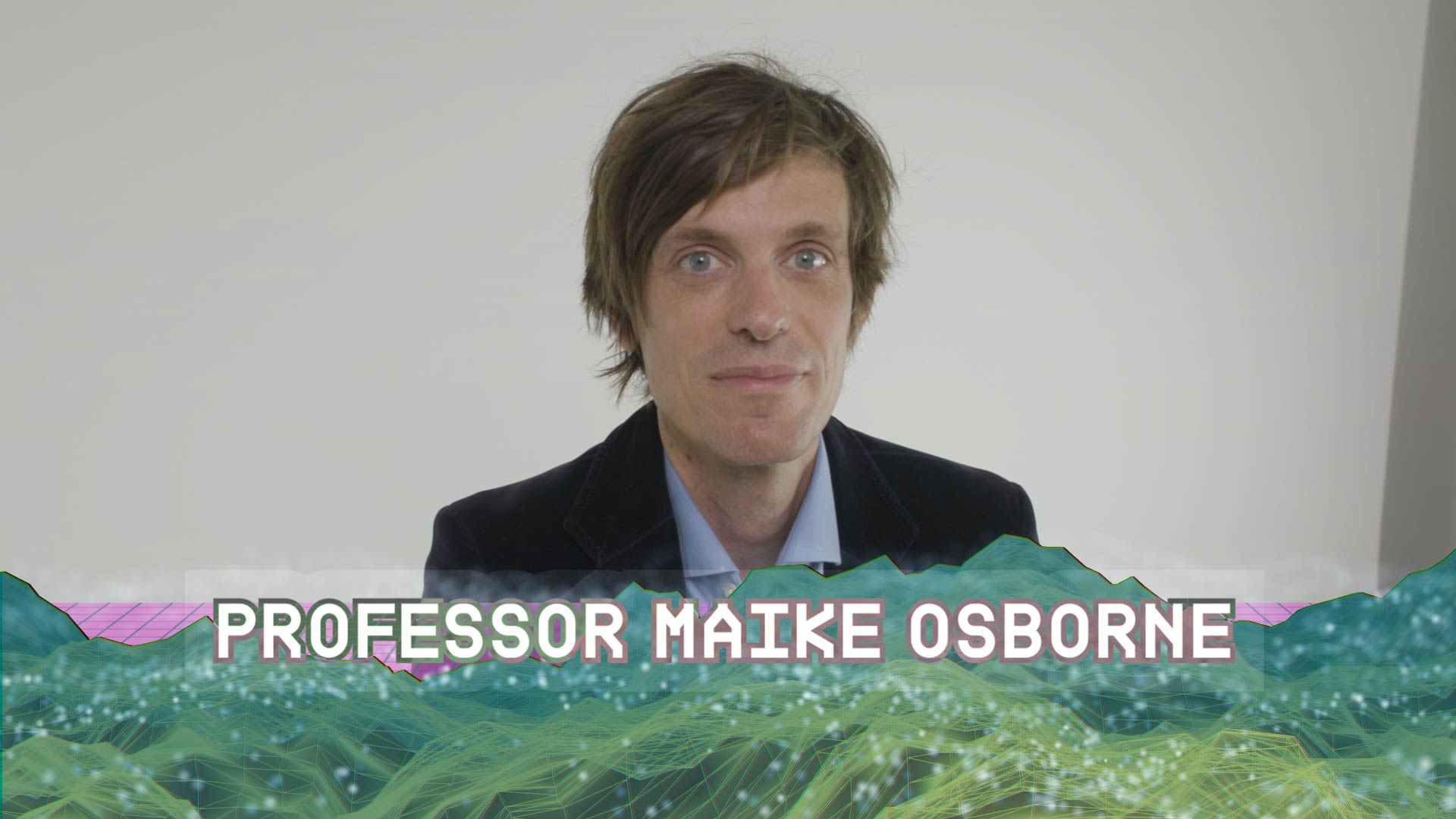
Professor Osborne is also interested in how AI might be changing the world around us.
In 2013 she wrote a paper with a friend and colleague, Professor Carl-Benedikt Frey, on exactly how much work might be automatable with advances in AI and robotics.
At the time, their headline finding was that 47% of work might be automatable with AI and robotics.
Now, a decade on, many of these themes have returned to people's awareness because of advances in generative AI, such as ChatGPT, which became the fastest-growing consumer application of all time.
This achieved a user base of 100 million users in fewer than three months and many people today are wondering whether this new wave of technology might lead to the replacement of human labour.
She continuously works to understand how these impacts might diffuse across labour markets and has launched a new initiative at the Oxford Martin School with colleague Professor Robert Trager, to understand what should be done about the sweeping changes within AI.
The Oxford Martin AI Governance Initiative focuses on the governance of AI and what the regulatory and political solutions might be – to head off some of the potential harms of these technologies, as well as the many real benefits they might deliver.
‘The Bayesian approaches to AI that we've been developing can actually meet real world user needs.’
Professor Osborne finds Oxford an amazing place for research, particularly when it comes to AI, with its dense concentration of researchers and proximity to similar hotspots of innovation, including Cambridge and London.
For her, the unique thing about Oxford is combining strengths, not just in AI algorithmic developments but in extending them to the real world.
This involves use cases with deep theoretical research underpinning what the impact of AI might be.
Her work stretches beyond the Department of Engineering Science, working with colleagues across Computer Science, Philosophy, Economics, and Governance.
All of them reflect on the broader ramifications of rapidly developing technologies. For Professor Osborne, having these experts across all disciplines thinking about core issues related to technologies makes a stimulating academic mix.
AI technology has never developed as quickly and as broadly as it has in the last few months, and Professor Osborne sees this as an exciting pivot point in the history of the field, where perhaps for the first time, hundreds of millions of people across the world are using AI in their day-to-day lives, especially seeing how it might impact upon their work and lifestyles.
The regulating of these technologies and making sure it is implemented in the right ways to deliver human flourishing, rather than causing harm, is critical for her.

Looking ahead at the next five to ten years, Professor Osborne is concerned about some of the harms that AI could bring.
She’s concerned we might see disenfranchisement of already marginalised groups in society, because AI is prone to biased decision-making - for instance, Dutch tax authorities have used algorithms to prosecute benefits claimants.
She is also concerned about the advances AI has made within large language models like the GPT engines that power ChatGPT, that are capable of many tasks performed by a human worker.
Professor Osborne appeared on Jimmy's Jobs of the Future to discuss how the workforce could be impacted by AI.
Her concerns are not necessarily that AI will lead to wide-scale unemployment, but instead that AI might lead to the immiseration of workers in the form of loss of income.
Professor Osborne refers to historical similarities, such as the Industrial Revolution, when an immense amount of wealth and wellbeing were unleashed by the technologies, which led to the exacerbation of inequality.
It took 60 years in the Industrial Revolution for the average worker to see any wage increases, against a political landscape which included the Luddites.
Luddites were people violently opposed to technological change, such as the introduction of new machinery in the wool industry. Luddites protested against changes that were part of a new market system they thought would make their lives much worse.
‘Never before has it been more important to think through how we go about regulating and governing these technologies.’
Looking ahead, Professor Osborne refers to some of these developments, such as the impact ride-hailing app Uber has had on taxi drivers.
Taxi drivers protested against these changes; the introduction of Uber led to a loss of income and created unstable working conditions.
This is already happening in Uber cities - that led to a loss of income of about 10% for taxi drivers and certainly led to job conditions becoming less stable. These impacts might be felt simultaneously in quite diverse occupations.
Her final worry is about humanity potentially losing control over AI. With the increasing role of corporations in society, she fears a loss of rights and dignity for human beings, and AI systems taking over decision-making power in societies.
Professor Osborne's biggest drive is to head off some of the harms that we may inadvertently be heading towards.
In 2023, she and many others signed open letters protesting against the rapid and unregulated pace of change driven by the largest tech firms such as Microsoft and Google.
The first thing she wants funding to do is to make sure that AI is not solely being governed by these large tech firms, but instead steered by democratic society.
If Professor Osborne had this kind of funding, she says, she would be directing it toward the forms of AI that best serve the needs of citizens as individuals, not just the commercial interests of small, powerful, and opaque tech firms.

Professor Osborne is concerned about the role these technologies might play in destabilising the geopolitical balance of peace.
It is no secret that China is also pushing ahead with the development of AI, and one of the flash points of geopolitical conflicts today is Taiwan.
Taiwan is responsible for building the chips that power most AI development today and, for Professor Osborne, funding could be well put to thinking through what the right solutions might be to relax the geopolitical situation at present to developing alternative forms of AI, and making sure that it is not being driven just by the commercial interests of a small number of tech players, but aligned with human societies.
‘I am concerned that we might see disenfranchisement of already marginalised groups in our society.’
aa
Maike is also worried about AI in the hands of malicious actors, including rogue states and criminals.
For example, criminals could potentially train AI to perfectly mimic voice's using recordings on social media. Parents could then receive a phone call from this mimic asking for an emergency transfer of funds.

The final harms Professor Osborne is worried about centre on the potential for AI to pose existential risks that might threaten the continued survival of our entire species.
We already have technologies that pose such threats. However, we should not take too much confidence from the fact that we have survived 60 years with nuclear weapons, because we are going to have to continue to survive with massive arsenals of these weapons available.
Professor Osborne talks about the societal risks of AI.
Some people have even proposed the integration of AI into nuclear command and control.
The role of AI in exacerbating biological threats is also a concern to Professor Osborne. AI could potentially be used to design an exceptionally lethal virus.
‘The first thing I'd want funding to do is to make sure that AI isn't solely being governed by these large, opaque tech firms, but is instead being steered by democratic societies.’
The future of AI has never been more uncertain, Professor Osborne says, as technology is developing rapidly, yet is in the hands of hundreds of millions of people, all of whom are thinking through how they could use AI to further their interests.
Professor Osborne argues that, while the obstacles to replacing human intelligence and creativity seem to remain the highest, it is difficult to predict what machines will not be able to do within the next 10 years.
However, she says, we still need quite a lot of human creativity to get anything out of generative AI, at least for the foreseeable future.

 Built with Shorthand